
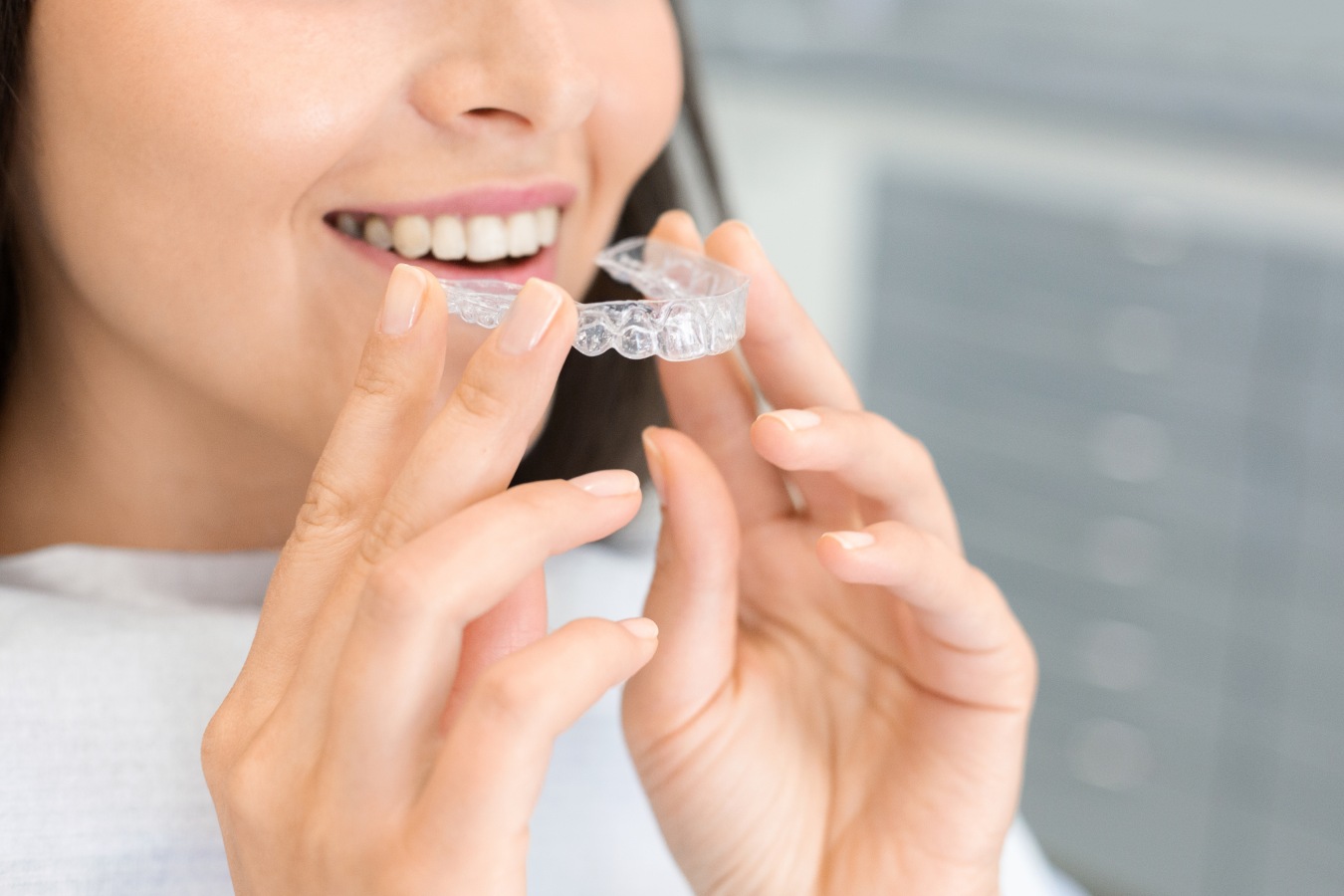
Clear aligners have changed the way people think about straightening teeth. Why Invisalign continues to be a top choice for adults and teens comes down to three practical things: the trays are hard to notice, they come out for meals, and they fit into a busy life at work, at school, and everywhere in between.
At Hometown Orthodontics, clear aligners are one of the most requested treatments our orthodontists plan every year, and the questions families ask about them tend to follow the same pattern: how long does treatment take, what does it cost, and does it really work as well as braces?
Below, our orthodontists walk you through how the process works, what it costs, who qualifies, and how aligners compare to braces.
What Is Invisalign?
Invisalign is an orthodontic treatment that uses a series of custom-made, removable clear plastic aligners to move teeth into better positions. Each tray is worn 20 to 22 hours per day and swapped for the next one in the series roughly every one to two weeks, applying gentle pressure that shifts teeth a small amount at a time.
Because the trays are removable, you take them out to eat, brush, and floss. That single feature is what makes aligners feel so different from fixed braces, and it’s the reason many adults finally move forward with treatment they’ve been putting off for years.
Your aligners are designed from a 3D digital scan of your teeth rather than the old putty impressions, so there’s no goop and no gagging. The scan feeds directly into the design software that maps out each stage of tooth movement, and our orthodontists review and refine that plan before a single tray is ever manufactured.
Invisalign treats a long list of concerns, including:
- Crowding and crooked teeth
- Gaps and spacing
- Overbite and underbite
- Crossbite
- Open bite
How Invisalign Treatment Works, Step by Step
The process is straightforward, and most of the hard work happens before you ever put in your first tray.
- FREE consultation and exam. Our orthodontists examine your bite, review your dental history, and talk through what bothers you about your smile. This visit confirms whether aligners, braces, or another option makes the most sense.
- Digital intraoral scanning. A handheld scanner captures a detailed 3D model of your teeth in minutes. No putty impressions, and far less time in the chair.
- Your digital plan. We use the scan to map each stage of movement and preview the projected final result before treatment begins. Seeing the “after” up front helps you make a confident decision.
- Aligner fabrication. Your custom series is manufactured, and small tooth-colored attachments may be bonded to certain teeth. These attachments give the aligners something to grip so they can rotate or upright a stubborn tooth.
- Wear, switch, and check in. You’ll move to the next tray on schedule and stop by for progress checks, typically every 6 to 10 weeks depending on your personalized plan.
- Retainers. Once active treatment wraps up, retainers hold everything in place. The American Association of Orthodontists recommends wearing retainers as directed to maintain results long term.
Most aligner treatment runs 12 to 24 months, though minor corrections often finish faster and complex bites take longer.
Benefits of Invisalign for Adults and Teens
Adults and teens tend to want the same two things: real results and a treatment that doesn’t take over their life. Aligners deliver on both.
Are Invisalign trays really that hard to notice?
Invisalign trays are completely clear, so they don’t detract from your face or your smile. In a work meeting, a classroom presentation, or a wedding photo, most people never notice them.
Can you eat whatever you want with aligners?
Yes. Popcorn at the movies, gum on the drive home, apples, corn on the cob, chips. Take the trays out, eat, brush, and put them back in. That’s it.
Does brushing and flossing stay simple?
There’s no threading floss around wires or working a brush between brackets. Good hygiene during treatment protects your enamel and gums, and removable aligners make that far easier to keep up day after day.
Are clear aligners more comfortable than braces?
Comfort is a big difference. The plastic edges are smooth and rounded, so you avoid the cheek and lip irritation that brackets and wires can cause during the first few weeks.
Do aligners mean fewer surprise problems?
There are no brackets to pop off during a football game and no wires to start poking on a Friday night. That means fewer emergency visits and fewer disruptions to your schedule.
How do parents know teens are wearing their trays?
Aligners designed for teens include compliance indicators, small colored dots that fade with wear, so parents and our orthodontists can see whether the trays are getting the hours they need.
One more benefit that families mention often: orthodontic treatment is about much more than straight teeth. It improves bite function, protects long-term oral health, guides proper jaw development, and most importantly results in increased confidence.
Invisalign vs. Traditional and Clear Braces
Both approaches can produce excellent results in the right case. The difference is in the daily experience and in how much the outcome depends on you.
| Factor | Invisalign | Traditional Metal Braces | Clear (Ceramic) Braces |
|---|---|---|---|
| Visibility | Nearly invisible | Most noticeable | Much less noticeable than metal |
| Removable | Yes, for eating and cleaning | No, fixed in place | No, fixed in place |
| Comfort | Smooth plastic edges | Brackets and wires may irritate | Similar to metal brackets |
| Hygiene | Brush and floss normally | Requires extra tools and time | Requires extra tools and time |
| Food limits | None while trays are out | Avoid hard, sticky, chewy foods | Avoid hard, sticky, chewy foods |
| Visit frequency | Periodic progress checks | Regular adjustment visits | Regular adjustment visits |
| Depends on wear time | Yes, 20 to 22 hours daily | No, works continuously | No, works continuously |
Braces have one clear advantage: they work around the clock whether you’re motivated that week or not. Aligners only work while they’re in your mouth, so consistent daily wear determines whether you finish on time.
Certain corrections also respond better to fixed appliances. Significant rotations, large bite discrepancies, and cases needing precise control over individual teeth may call for braces.
If you want something subtle but aren’t an aligner candidate, you still have options. Clear braces are much less noticeable than metal braces and offer an aesthetic alternative for patients seeking other options. Lingual braces have the same components as conventional braces, but they’re fixed to the back, or lingual, side of your teeth, which keeps them completely out of view when you smile.
What Affects the Cost of Invisalign
There is no one-size-fits-all price. Cases involving mild spacing and a handful of trays cost less than full bite correction requiring dozens of aligners, attachments, and refinement trays at the end.
| Cost Factor | How It Affects Your Fee |
|---|---|
| Number of aligner trays | More trays and more stages mean a higher fee |
| Length of treatment | Longer treatment involves more visits and monitoring |
| Attachments, elastics, refinements | Extra components add clinical time and materials |
| Orthodontic insurance benefits | Many dental plans include orthodontic coverage, though amounts vary by plan |
| FSA or HSA funds | Pre-tax dollars can be applied toward treatment |
| Payment plans | Monthly options with a down payment spread the cost out |
| Retainers and follow-up | Some fee structures include retainers; others bill separately |
Who Is a Good Candidate for Invisalign?
Good Invisalign candidates have mild to moderate crowding, spacing, or bite irregularity, along with healthy teeth and gums. Teens should have most of their permanent teeth in place and be willing to wear trays 20 to 22 hours a day. Adults whose teeth shifted after previous braces are often a great fit for aligners.
Here’s what our orthodontists look at:
- Type and severity of the problem. Mild to moderate crowding, spacing, and bite issues respond well to aligners.
- Dental development. Teens generally need most permanent teeth erupted before aligner treatment begins. The AAO recommends a first orthodontic evaluation by age 7, which helps us time treatment correctly.
- Wear-time discipline. Aligners work when they’re worn. Compliance indicators help, but the habit matters most.
- Gum and tooth health. Active decay or gum disease is addressed before any tooth movement starts.
- Skeletal considerations. Severe jaw discrepancies may require braces, growth-guiding appliances, or coordination with an oral surgeon.
At Hometown Orthodontics, a visit with digital scans and X-rays is the only reliable way to confirm candidacy. Digital radiography offers the advantages of reduced radiation, clearer images for diagnosis, and less wait time for patients, so that evaluation is quick and comfortable from start to finish.
Why Families Trust Our Orthodontists with Aligner Treatment
Aligner results depend heavily on the person planning them. Software maps the movements, but an experienced orthodontist decides what’s realistic, where attachments go, and when to adjust course. That clinical judgment is what the Hometown Orthodontics family brings to every case we accept.
Dr. Rape is a board-certified orthodontist and a Diplomate of the American Board of Orthodontics, a voluntary credential that requires demonstrating clinical excellence and renewing certification over time. He has more than 35 years in private practice, has been voted one of America’s Top Orthodontists by the Consumers’ Research Council of America, and has served as a Clinical Professor at the UAB School of Dentistry.
Dr. Jared Teeples, DDS, MS, earned his BS from Brigham Young University–Idaho and his DDS with High Honors from the University of Utah School of Dentistry, where he was inducted into Omicron Kappa Upsilon. He completed his orthodontic residency and MS at the University of Alabama at Birmingham, served as Chief Orthodontic Resident, and continues to teach as a Part-Time Clinical Professor in the UAB Orthodontic Department.
Both doctors are Invisalign providers, and our practice was honored with a 2023 BOB Award. Families regularly leave five-star reviews describing the care they received from our awesome staff.
Creating beautiful smiles and striving to make a difference in the lives of others on a daily basis is the essence of our practice. That’s why our awesome staff greets you by name and why so many people leave feeling like family. Welcome to the hometown family.
Frequently Asked Questions About Invisalign
How long does Invisalign take for adults and teens?
Most aligner cases fall somewhere between 12 and 24 months, though minor corrections can finish sooner. Your total time depends on how far your teeth need to move and how consistently you wear your trays. Our orthodontists give you an estimated timeline at your FREE consultation once we’ve reviewed your digital scan.
Does Invisalign hurt or feel uncomfortable at first?
You’ll feel pressure and mild soreness for a day or two after switching to a new tray, which is a sign the aligner is doing its job. That sensation fades as your teeth settle. Most people describe aligners as more comfortable than braces because there are no brackets or wires rubbing against the cheeks and lips.
Can I drink coffee or eat with aligners in?
No, you should take aligners out for anything other than plain water. Hot coffee can warp the plastic, and coffee, tea, red wine, and sodas can stain the trays or trap sugar against your enamel. Take them out, enjoy your drink or meal, brush, then pop them back in.
Will Invisalign affect my speech?
Some people notice a slight lisp during the first few days as their tongue adapts to the thin plastic. It almost always clears up quickly, and talking through it speeds up the adjustment. By week two, most patients forget the trays are there.
Do teens really wear their aligners enough for it to work?
Most do, especially when they’re motivated by keeping their smile natural-looking throughout treatment. Teen aligners include compliance indicators that fade with wear, giving parents and our orthodontists a simple way to check hours. If wear time slips at progress visits, we talk it through honestly and adjust the approach.
Do I need retainers after Invisalign treatment?
Yes. Teeth naturally drift over time, and retainers are what keep your results stable. The American Association of Orthodontists recommends retainer wear as directed after any orthodontic treatment, and we’ll show you exactly how to care for yours so your confident, healthy smile stays that way.