
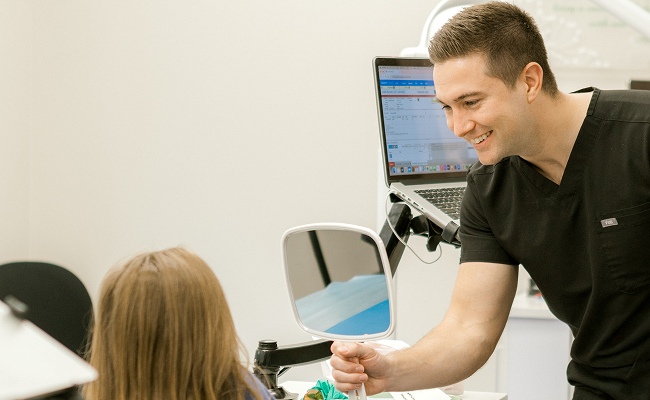
Parents keep asking how digital orthodontics is improving patient care for families, and the honest answer comes down to three things: comfort, accuracy, and clearer conversations about your child’s smile. At Hometown Orthodontics, digital scanning and digital X-rays have replaced putty trays and film, so you spend less time in the chair and more time actually understanding the plan. The shift sounds technical when you read about it, but the day-to-day difference is simple enough that most nine-year-olds can explain it to a sibling after a single visit.
What Is Digital Orthodontics?
Digital orthodontics uses 3D intraoral scanning, digital imaging, and software-driven planning in place of analog impressions and film X-rays. A small wand captures your teeth as a precise 3D model, digital radiographs capture the structures underneath, and planning software helps our orthodontists design and simulate movement before treatment ever begins.
That’s the definition. Here’s what it looks like in practice, from the moment the wand comes out of its cradle to the day your retainer is delivered.
What Are the Core Technology Categories?
Most digital orthodontic care is built on four tools that work together:
- Intraoral scanners. A handheld wand photographs thousands of points inside the mouth and stitches them into a full 3D model of both arches and the bite.
- Digital radiography. Digital X-rays replace film and processing chemicals. Digital radiography offers reduced radiation, clearer images for diagnosis, and less wait time for you.
- Treatment simulation software. Our orthodontists move teeth virtually, test different sequences, and preview a projected result before any bracket or aligner exists.
- Digital fabrication. Scan files travel electronically to the lab or aligner manufacturer, where appliances and trays are built directly from your model.
How Does This Differ From the Old Way?
The traditional workflow had a lot of moving parts. A tray full of impression material went into the mouth and stayed there while it set. That impression became a plaster model. The model got boxed up and mailed to a lab. Film X-rays needed developing, and every physical record had to be stored on a shelf somewhere.
Each of those steps introduced a chance for distortion, breakage, or delay. A cracked model or a warped impression meant a repeat visit.
Digital records skip most of that. Intraoral digital scanning improves your experience by eliminating the need for “goop and gag” impressions, and the file itself can’t crack, warp, or get lost in the mail.
Why Do Families Notice the Difference?
Kids feel it first. There’s no material to hold still for, no gagging, and no waiting while something sets.
Parents notice it second. You get to see the 3D model on the screen with your child, watch our orthodontists point to the crowding or the crossbite, and look at a simulated outcome before you commit to anything. Questions get answered while you’re looking at the same picture, which takes a lot of guesswork out of the decision. Instead of nodding along to clinical vocabulary, you can point at a specific tooth on the monitor and ask what happens to it.
Fewer visits help too. When scans transmit electronically and appliances fit correctly the first time, there’s less back-and-forth for adjustments and remakes.
Is This Just for Clear Aligners?
A common misunderstanding: digital tools are only for Invisalign. They’re not.
The same scan that produces aligner trays also supports traditional metal braces, clear braces, lingual braces bonded to the back of the teeth, expanders, and retainers. Digital records improve planning and appliance fit no matter which option ends up in your personalized plan.
The Digital Visit for Families, Step by Step
A digital orthodontic visit follows five steps: records are captured with a scanner and digital X-rays in minutes, a 3D model builds instantly for review, planning software simulates projected movement and timeline, the file transmits electronically for fabrication, and follow-up scans track progress against the original model. No putty, no plaster, no mailed molds.
Step 1: What Happens at the Digital Records Visit?
Your first real appointment after the free consultation is records day, and it’s shorter than most families expect.
Our awesome staff captures three things: an intraoral scan of the upper and lower teeth, digital X-rays, and a set of clinical photos. The scan is done with a wand about the size of an electric toothbrush handle. Nothing sets, nothing hardens, and nothing sits in the mouth waiting.
Most kids ask to see the screen halfway through, which is honestly the best part. A few of them ask to hold the wand, which we politely decline while promising a better look at the finished model.
Step 2: How Quickly Does the 3D Model Appear?
The model appears on the monitor as it’s being captured. That means our orthodontists can review it with you in the room instead of calling you back a week later.
At this stage, we’re looking at:
- Bite relationship, including overbite, underbite, and crossbite patterns
- Crowding, spacing, and arch width
- Eruption sequence and whether permanent teeth have room to arrive
- Jaw growth patterns and, when relevant, airway or breathing concerns
- Wear patterns that suggest the bite is working harder than it should
Step 3: What Does the Simulation Show?
Planning software lets our orthodontists move the digital teeth in stages. You see roughly where the teeth start, where they’re headed, and about how long each phase should take.
This is a projection, not a promise. Biology sets the real pace, and every mouth responds a little differently. Still, seeing a before-and-after preview helps teens buy in and helps parents plan around school years and sports seasons.
Step 4: How Does the File Get to the Lab?
Once the plan is approved, the digital file goes out electronically. Aligner trays, expanders, indirect bonding trays, and retainers are all built from that file.
Nothing gets shipped in a box. Because the file travels electronically, it can’t arrive at the lab cracked, chipped, or crushed in transit. Turnaround shortens because the file lands in the lab’s queue the same day it leaves our doors, and we can resend it in seconds if anything needs a second look.
Step 5: How Is Progress Monitored?
During treatment, you’ll come in every 4-8 weeks depending on your personalized plan. When it’s helpful, we take a fresh scan and lay it over the original model.
That overlay shows exactly how far each tooth has traveled. If a tooth is lagging or an aligner isn’t tracking, we catch it early and adjust rather than discovering it months down the road. Small course corrections made early tend to keep the overall timeline intact.
What Does the Scan Actually Feel Like for a Child?
Parents ask about this more than anything else, so here’s the plain description.
Your child sits up, mouth open, while the assistant glides a wand across the chewing surfaces, then the outside, then the inside. There’s no tray, no putty, and no pressure against the soft palate, which is what triggers gagging with conventional impressions.
The scan pauses and resumes at any point. If a younger child needs a break, we stop, let them swallow and reset, and pick up exactly where we left off. Nothing has to start over.
For gag-sensitive kids and children with sensory sensitivities, that pause-and-resume ability changes the whole experience.
Benefits of Digital Orthodontics for Families and Parents
The advantages show up in comfort, precision, safety, speed, and understanding. Here’s how each one plays out in real treatment.
How Much More Comfortable Is It on Day One?
Impression material was the single most disliked part of orthodontic records for decades. It tasted strange, it felt heavy, and it made a lot of kids gag.
Digital scanning removes it completely. For children, gag-sensitive family members, and anyone with a strong startle response, that’s a meaningful upgrade. Parents who remember their own impressions from the 1990s tend to be the most surprised by the change.
How Does Accuracy Improve Appliance Fit?
Conventional impressions can distort. The material shifts, the tray moves, or the plaster model chips during transport.
Digital scans capture the surfaces directly and don’t change shape afterward. Better accuracy means aligners seat properly, expanders fit the arch, and retainers hold the result. Fewer remakes also mean fewer extra visits you didn’t plan for, which matters when you’re already juggling school pickup and practice schedules.
How Much Radiation Does Digital Imaging Use?
Digital radiography exposes your child to less radiation than conventional film while producing clearer diagnostic images. We take X-rays only when there’s a clinical reason to, and the digital format means no waiting on processing. Because the images appear on the monitor within seconds, our orthodontists can walk you through an unerupted tooth or a root position question while you’re still in the room rather than over the phone days later.
Why Is Turnaround Faster at Every Handoff?
Mail used to be a bottleneck. Now files transmit electronically, so the lab starts sooner and appliances come back sooner.
Treatment still takes as long as tooth movement takes. But the administrative waiting between steps shrinks considerably, and those saved weeks add up across a two-year case.
How Does This Help Parents and Kids Understand Treatment?
This benefit may matter most. When a 3D model is up on the screen, orthodontic problems stop being abstract.
You can see the crowded lower incisors. Your teen can see why the upper arch needs width. A simulated outcome gives everyone a shared picture of what treatment is working toward, which makes conversations about aligner wear and rubber bands a lot easier at home. Kids who understand the goal tend to argue about it far less.
Why Do Digital Records Stay Retrievable?
Physical models took up shelf space and eventually got discarded. Digital files don’t.
Because your scan is stored digitally, we can:
- Share records with your general dentist when needed
- Reuse the file to fabricate a replacement retainer without new impressions
- Compare current scans against your original model years later
- Coordinate records for multiple siblings without hunting through storage
Digital vs. Traditional Orthodontic Records: A Side-by-Side Comparison
Both approaches can produce excellent results in skilled hands. The differences show up in the experience, the margin for error, and the time it takes to get from records to appliance.
| Factor | Digital workflow | Traditional workflow |
|---|---|---|
| Impression method | Handheld wand scan, nothing in the mouth | Tray filled with putty, held in place while it sets |
| Chair time for records | Roughly 5-10 minutes for both arches | Longer, with setting time and possible retakes |
| Comfort level | No material, no tray, pause and resume anytime | Bulky trays, common gagging, unpleasant taste |
| Accuracy | High precision, model doesn’t change shape | Distortion possible from movement or shrinkage |
| Radiation | Reduced with digital radiography | Higher with conventional film |
| Lab turnaround | Electronic transfer, same-day submission | Model boxed and mailed, plus film processing |
| Record storage | Digital files, retrievable for years | Physical plaster models, shelf space required |
| Remake risk | Lower; file can be resubmitted | Higher; broken or warped models mean repeat visits |
What Hasn’t Changed?
Technology is a tool, not a shortcut. Three things still drive your result, and none of them come from a scanner.
Clinical judgment. Software shows what movement is possible. A board-certified orthodontist decides what’s appropriate for your growth pattern, bite, and long-term oral health.
Monitoring visits. You’ll still come in regularly so our orthodontists can check tracking, adjust wires, and respond to what the teeth are actually doing.
Compliance. Aligners work when they’re worn. Rubber bands work when they’re hooked. Retainers hold when they’re used. No amount of digital planning replaces daily habits, and that part stays a family project from start to finish.
What Happens When a Retainer Gets Lost?
Retainers get lost in lunch bags, hotel rooms, and car consoles. It happens to nearly every family eventually.
With a digital file on record, we can often produce a replacement retainer without bringing you in for a new impression. That saves a visit and a fair amount of frustration.
How Much Does Digital Orthodontic Treatment Cost?
Digital tools are typically included in your overall treatment fee rather than billed as a separate line item. Cost depends on case complexity, how long treatment takes, the appliance type you choose, and your retention plan. There’s no one-size-fits-all price, which is why a free consultation gives you a real number instead of a guess.
What Are the Main Cost Drivers?
| Factor | How it affects your fee |
|---|---|
| Case complexity | Mild spacing costs less to correct than a significant bite discrepancy |
| Treatment length | Longer treatment means more visits and more chair time |
| Appliance type | Metal braces, clear braces, lingual braces, and clear aligners are priced differently |
| Phase of treatment | Early interceptive treatment for a child is usually a smaller fee than full treatment later |
| Retention plan | The type and number of retainers factors into the total |
What Should Families Ask About?
Money conversations go better when everything is on the table. Bring these up at your consultation:
- Sibling coordination. Many families have two or three kids who will need treatment, sometimes overlapping. Ask how scheduling and payments can line up.
- Orthodontic insurance benefits. Many dental plans include orthodontic benefits for children, though the amount of coverage varies quite a bit by plan.
- FSA and HSA dollars. Orthodontic treatment is generally an eligible expense, which lets you use pre-tax funds.
- Monthly payment options. Ask what a down payment and monthly figure look like for your specific case.
Where Can Digital Care Save Money?
Savings from digital records are indirect, but they’re real.
Accurate scans mean fewer appliance remakes. Well-fitting aligners and expanders mean fewer emergency visits for loose or poorly seated appliances. Stored digital files mean replacement retainers usually don’t require a new records visit.
None of that shows up as a discount on the treatment estimate. It shows up as fewer unplanned trips and fewer surprise costs during the two years your child is in treatment, and for a working parent, those avoided afternoons off have a value of their own.
Who Is a Good Candidate for Digital Orthodontic Care?
Nearly everyone in orthodontic care benefits from digital records: young children in early treatment, teens in braces or aligners, and adults returning for a second round. Digital scanning is especially valuable for gag-prone family members, kids with sensory sensitivities, anxious patients, and clear aligner candidates.
Which Family Members Benefit Most?
Some groups feel the difference immediately, while others benefit quietly through better appliance fit.
- Gag-prone kids and adults. Removing the tray and the putty removes the trigger, and that’s the biggest comfort improvement of all.
- Young children. A wand scan that pauses on request is far easier for a six or seven-year-old to tolerate.
- Patients with sensory sensitivities. A process that’s predictable, stoppable, and less invasive matters a great deal here.
- Anxious patients. Watching the model build on the screen turns a mystery into something you can actually see.
- Clear aligner candidates. Aligner fit depends directly on scan accuracy. A precise digital model means better tracking from the first tray.
How Does Growth Monitoring Work for Kids Ages 7 to 10?
The American Association of Orthodontists (AAO) recommends that kids have their first orthodontic evaluation by age 7. At that age your child has a mix of baby and adult teeth, jaw growth patterns are becoming clear, and subtle concerns can be caught early.
Many of these children don’t need treatment yet. They need periodic records so growth can be tracked over time.
Digital scans make that easy. Each new scan overlays on the previous one, so our orthodontists can see how the arches are developing and start treatment at the right moment rather than too early or too late.
When Is Conventional Imaging Still Needed?
Digital records handle most situations, though not all.
Certain evaluations, including some surgical planning cases and detailed airway assessments, call for advanced imaging or a referral to a specialist for additional views. Occasionally an unusual anatomical situation makes a conventional impression the better choice. Our orthodontists will tell you plainly if that’s the case for you.
What Is a Simple Next Step?
You don’t need to decide anything before you have information. A free consultation and a digital scan will clarify what each family member needs, whether that’s treatment now, monitoring for a couple of years, or nothing at all.
Why Families Trust Hometown Orthodontics
Braces are about much more than straight teeth. Orthodontic treatment improves bite function, protects long-term oral health, guides proper jaw development, and most importantly results in increased confidence.
Our orthodontists bring serious credentials to that work. Dr. Rape is a board-certified orthodontist and Diplomate of the American Board of Orthodontics, has served as a Clinical Professor at the UAB School of Dentistry, and brings more than 35 years of private practice experience to the cases he reviews. Dr. Jared Teeples, DDS, MS, earned his BS from Brigham Young University–Idaho, his DDS with High Honors from the University of Utah School of Dentistry, and completed his orthodontic residency and MS at the University of Alabama at Birmingham, where he served as Chief Orthodontic Resident and now teaches as a Part-Time Clinical Professor in the UAB Orthodontic Department. He was also inducted into Omicron Kappa Upsilon, the national dental honor society.
Families who have sat in our chairs have left behind extensive five-star reviews over the years, and several members of our awesome staff have been part of the Hometown Orthodontics family for more than two decades, which means the person handing your child a scanner wand has very likely done it thousands of times.
Creating beautiful smiles and striving to make a difference in the lives of others on a daily basis is the essence of our practice. Our prayer is that we bring a smile to those who walk through our doors and leave feeling like family. That’s the reason we invested in digital tools in the first place: less discomfort for your child, clearer answers for you, and more time spent talking through the plan instead of waiting on plaster to set. Welcome to the hometown family.
Frequently Asked Questions About Digital Orthodontics
Does a digital scan hurt or cause gagging?
No. There’s no impression material and no tray pressing against the back of the mouth, which is what usually triggers gagging. The scanner is a handheld wand that glides across the teeth, and it can be paused at any moment for a break without restarting the scan. Most kids describe it as strange but easy.
How long does an intraoral scan take?
A full scan of both the upper and lower arches typically takes about 5-10 minutes, including the bite registration. Younger children or patients who need frequent breaks may take a little longer, and that’s completely fine. Compare that to conventional impressions, where setting time and occasional retakes stretched the visit considerably.
Are digital X-rays safe for children?
Yes. Digital radiography uses less radiation than conventional film while producing clearer images for diagnosis, and there’s no wait for processing. We take radiographs only when there’s a clinical reason, such as checking for unerupted teeth, root position, or jaw development. Our orthodontists will explain what each image is for before it’s taken.
Can digital scanning replace impressions for retainers?
Usually, yes. Retainers can be fabricated directly from your digital scan, and because that file stays on record, a lost or broken retainer often doesn’t require a new records visit. This saves families time and reduces the chance of teeth shifting while a replacement is being made.
Will digital treatment be faster or cheaper?
Planning moves faster, lab turnaround shortens, and remakes drop significantly. That said, teeth move at the pace biology allows, so digital tools don’t shrink a 24-month case into 12 months. The savings tend to show up as fewer unplanned visits and fewer replacement appliances rather than as a lower sticker price.
Do I get to see the plan before treatment starts?
Yes, and we think that’s one of the best parts. You’ll look at the 3D model together with our orthodontists, see where the teeth are now, and view a simulation of the projected result. Nobody should agree to treatment they haven’t seen explained. If a question comes up later, shoot us an e-mail and our awesome staff will walk you through it again.