
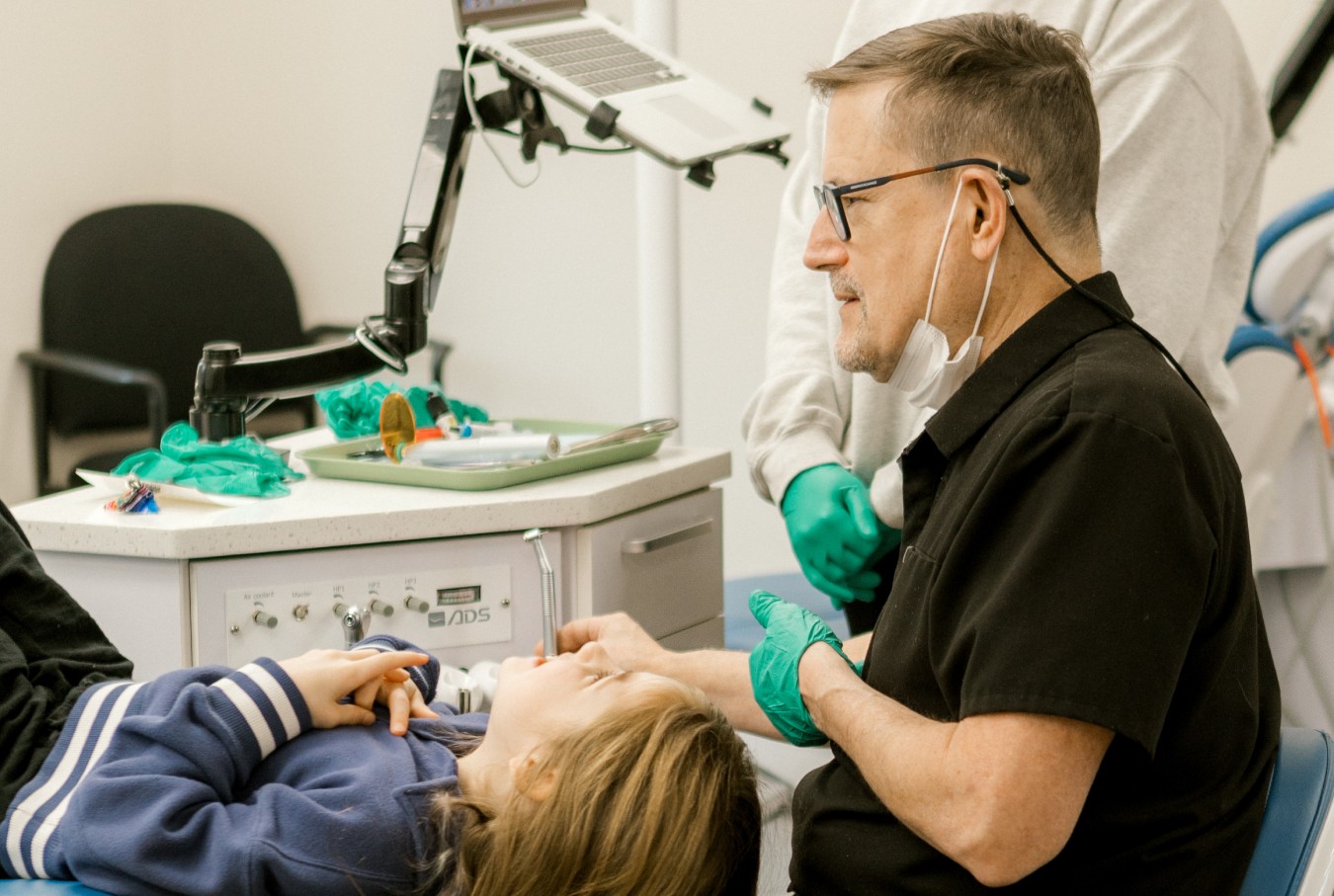
Parents often ask why we’d start two-phase orthodontic treatment as early as age 8 instead of waiting, and the answer is all about timing. Kids grow. When we work alongside that growth instead of waiting for it to finish, we can often correct problems that would take much more effort later. Families in Pinson and Oneonta bring this question to us nearly every week, and at Hometown Orthodontics the conversation almost always begins with the same question in return: how much growing does your child still have ahead of them?
What Is Two-Phase Orthodontic Treatment?
Two-phase orthodontic treatment splits care into two active stages separated by a resting period: an early interceptive phase during childhood, a pause while the remaining permanent teeth come in, and a second phase with braces or aligners. Phase One usually starts between ages 7 and 10, while the jaws are still growing and easier to guide.
The purpose of Phase One isn’t perfectly straight teeth. It’s structure. Our orthodontists use this window to guide jaw growth, widen a narrow upper arch, correct a bite that shifts to one side, and create room so permanent teeth have somewhere to go. Because our board-certified orthodontist, Dr. Rape, and Dr. Teeples both plan around growth records rather than birthdays alone, two children the same age can walk out with very different recommendations. Early orthodontic treatment is always matched to the child in the chair, and the families we see throughout Blount County hear that from us on day one.
Single-phase treatment works differently. It waits until nearly all the permanent teeth have erupted, usually around ages 11 to 13, then straightens everything at once with braces or clear aligners.
Both approaches have their place. The difference is that one of them can address skeletal concerns while bone is still developing, and the other mostly moves teeth after growth has slowed.
According to the American Association of Orthodontists, every child should have a first orthodontic evaluation by age 7. That visit doesn’t mean braces are going on that day. It simply gives us a baseline, and it tells us whether waiting is smart or whether early help would make a real difference.
How Does Two-Phase Orthodontic Treatment Work? Phase One, Resting Period, Phase Two
Two-phase treatment follows three stages. Phase One runs roughly 6 to 12 months with appliances like expanders or partial braces, the resting period lasts about 1 to 3 years while remaining permanent teeth erupt, and Phase Two uses full braces or aligners for about 12 to 24 months to align teeth and refine the bite. Those ranges reflect standard clinical practice and the growth-based timing the American Association of Orthodontists describes, and individual cases can land on either side of them.
Here’s what each stage looks like in practice.
What Happens During Phase One? (About 6 to 12 Months)
- Palatal expanders widen a narrow upper jaw so the bite lines up and crowded teeth gain space
- Partial braces on a few key teeth reposition protruding front teeth or correct an individual crossbite
- Habit appliances help a child stop thumb sucking or tongue thrusting before it reshapes the bite
- Space maintainers hold room open when a baby tooth is lost too early
What Happens During the Resting Period? (About 1 to 3 Years)
Nothing is “on hold” during this stage, even though active appliances usually come off. Your child wears a retainer or holding appliance in many cases, and we schedule periodic growth-check visits to watch how the permanent teeth erupt.
These check-in visits are short and low-stress. Our awesome staff tracks eruption patterns, jaw development, and any new crowding so nothing sneaks up on us.
What Happens During Phase Two? (About 12 to 24 Months)
Once most permanent teeth are in, Phase Two brings the finishing work: full braces, clear braces, or Invisalign to level, align, and detail the bite. Because the foundation was corrected earlier, this phase is often more straightforward than starting from scratch.
Technology helps at every stage. Digital X-rays give us clearer images with reduced radiation and less wait time, and intraoral digital scanning captures precise records with no more goop and gag impressions. Kids appreciate that part.
Benefits of Starting Early: Time Saved and Long-Term Results
Early treatment works with growth rather than against it, and that opens up options later care doesn’t have. Here’s what families gain most often.
How Does Early Treatment Save Time Later?
Most of the time savings come from handling the structural work while the body is still cooperating, which keeps the second stage shorter and far more predictable.
- Room created naturally instead of surgically. Widening an arch while it’s still developing can reduce the need to remove permanent teeth later.
- A shorter, simpler second phase. When skeletal issues are already handled, Phase Two frequently focuses on alignment alone.
- Problems caught before they compound. Crossbites, severe crowding, and oral habits tend to get worse, not better, with time.
What Long-Term Results Can Families Expect?
The results that matter most tend to be the ones nobody photographs: how a child bites, breathes, and holds a bite together five or ten years from now.
- Less risk of injury. Front teeth that stick out far are vulnerable during sports and playground falls. Pulling them back early protects them.
- Better everyday function. Chewing, breathing, and speech often improve alongside appearance, which matters far more than most people expect.
- More stable long-term results. Correcting the foundation early can reduce the odds that jaw surgery becomes the only option in the teen or adult years.
Braces are about much more than straight teeth. Orthodontic treatment helps improve bite function, protect long-term oral health, guide proper jaw development, and build genuine confidence along the way.
That last one shows up in ways parents don’t anticipate. A child who stops covering their mouth in photos has gained something bigger than alignment.
Two-Phase Treatment vs. Waiting for One-Phase Treatment
Neither path is automatically better. The right choice depends on what we see in your child’s records, so here’s a straight comparison.
| Factor | Two-Phase Treatment | Waiting for One-Phase Treatment |
|---|---|---|
| Typical start age | Ages 7 to 10 | Ages 11 to 13 |
| What it corrects | Skeletal growth, arch width, bite shifts, plus alignment later | Mainly tooth position after growth has slowed |
| Total appliance time | Split across two shorter stages with a rest between | One continuous stage, sometimes longer for complex cases |
| Extraction likelihood | Often lower, since space is created during growth | Higher when crowding is severe |
| Surgical risk for severe cases | Reduced in many cases | Greater for significant jaw discrepancies |
| Cost timing | Fees usually divided between two phases | One treatment fee at a later date |
Waiting isn’t wrong. Plenty of kids are better served by monitored observation, and our orthodontists say so when that’s the case. We’d rather watch a child grow for two years than start an appliance that growth would have handled on its own.
What we don’t recommend is ignoring a problem that’s clearly progressing. Crowding tends to worsen, teeth in crossbite wear unevenly, and a jaw that shifts to one side can develop noticeable asymmetry over time. Those are the situations where delay costs something real.
What Affects the Cost of Two-Phase Treatment
Two-phase treatment cost depends on four main factors: the type of appliance used in Phase One, how long Phase One lasts, the complexity of the bite, and which method you choose for Phase Two. Fees are typically divided between the two phases rather than charged all at once, with the resting period in between.
The truth is that there is no one-size-fits-all price. Here’s what moves the number:
| Cost Factor | Why It Matters |
|---|---|
| Phase One appliance | An expander, partial braces, or a habit appliance each carry different fees |
| Phase One length | Longer active treatment means more visits and adjustments |
| Bite complexity | Skeletal corrections require more planning and monitoring than mild crowding |
| Phase Two method | Metal braces, clear braces, Invisalign, and lingual braces are priced differently |
| Insurance benefits | Many dental plans include orthodontic coverage for children, though amounts and lifetime maximums vary |
It’s worth asking for a combined estimate that covers both phases when you come in for a free consultation. Our awesome staff can walk through what each stage involves, how insurance benefits typically apply, and which payment options fit your family’s budget, so the financial side is clear long before anything begins.
Is Your Child a Candidate for Phase One Treatment?
Some signs point clearly toward an early evaluation. Watch for these:
- Baby teeth lost very early or very late compared to siblings or classmates
- Crowding or teeth erupting behind others because there isn’t enough room
- A crossbite, where upper and lower teeth don’t line up properly
- A jaw that shifts to one side when your child bites down
- Upper front teeth that protrude noticeably past the lower teeth
- Thumb sucking or mouth breathing that continues past the toddler years
- Trouble chewing or biting, or speech concerns your dentist has flagged
Ages 7 to 10 is the sweet spot for assessment because enough permanent teeth have arrived to reveal the pattern, and plenty of growth remains to work with.
At this age: your child has a mix of baby and adult teeth, jaw growth patterns are becoming clear, and subtle concerns can be detected early.
At your child’s first visit, we take digital X-rays and intraoral scans, review the bite, and build a personalized plan around what the records actually show. Sometimes that plan is active Phase One care. Other times it’s growth observation with check-ins every six to twelve months, which costs nothing to start and tells us exactly when the timing is right.
Early evaluation removes the guesswork, and an informed answer costs a family very little. Our board-certified orthodontist, Dr. Rape, is a Diplomate of the American Board of Orthodontics and a Clinical Professor at the UAB School of Dentistry, and Dr. Teeples earned his DDS with High Honors from the University of Utah School of Dentistry before completing his orthodontic residency and MS at the University of Alabama at Birmingham, where he served as Chief Orthodontic Resident and now teaches as a Part-Time Clinical Professor. Between them, they bring decades of combined experience to every set of records they review, and that experience is usually what separates a case that needs attention now from one that can safely wait another year.
Creating beautiful smiles and striving to make a difference in the lives of others on a daily basis is the essence of our practice. Whether you’re reading this in Pinson, Oneonta, or somewhere in between, families who walk through our doors hear this same explanation, just with their own child’s X-rays on the screen, and our hope is always that they leave feeling like family.
Frequently Asked Questions About Two-Phase Orthodontic Treatment
At what age should a child see an orthodontist?
The American Association of Orthodontists recommends that kids should have their first orthodontic evaluation by the age of 7. By then, enough permanent teeth have come in for us to spot crossbites, crowding, and jaw growth concerns. Early evaluation doesn’t always lead to early treatment, and that first look is often just a baseline record and a free consultation about timing.
What is the advantage of two-phase orthodontic treatment?
The main advantage is timing. Phase One puts active jaw growth to work on skeletal and space problems that become much harder to change once growth slows, which often means fewer extractions and a shorter second stage. For children with significant crowding, a crossbite, or protruding front teeth, that head start can also lower the odds of jaw surgery later on.
How long does Phase One last?
Phase One typically runs 6 to 12 months of active appliance wear. Some corrections, like widening a narrow upper arch with an expander, finish faster. Cases involving significant jaw guidance or habit correction may take closer to a year.
Will my child still need braces later?
Usually yes. Phase One corrects the foundation, but permanent teeth still need to be aligned and detailed once they’ve all erupted. The upside is that Phase Two is often shorter and less complicated than treatment would have been without early care.
Can Invisalign be used in Phase Two?
Often, yes. Invisalign works well for cooperative teens who wear their trays as directed, and the trays are completely clear so they don’t detract from your face or smile. Our orthodontists review whether aligners or braces suit your teen’s specific bite before Phase Two begins.
Is two-phase treatment more expensive overall?
It depends on complexity. Two-phase care involves two separate fees, but it can reduce the need for extractions, extended braces, or jaw surgery later. Many families find the combined total comparable, and the fees are spread across several years rather than due at once.
What happens if we skip Phase One?
For mild cases, skipping Phase One and waiting is a perfectly reasonable choice. For significant skeletal issues, delay can mean removing permanent teeth, wearing braces longer, uneven tooth wear, or facing jaw surgery as a teen or adult. We’ll tell you honestly which category your child falls into.