
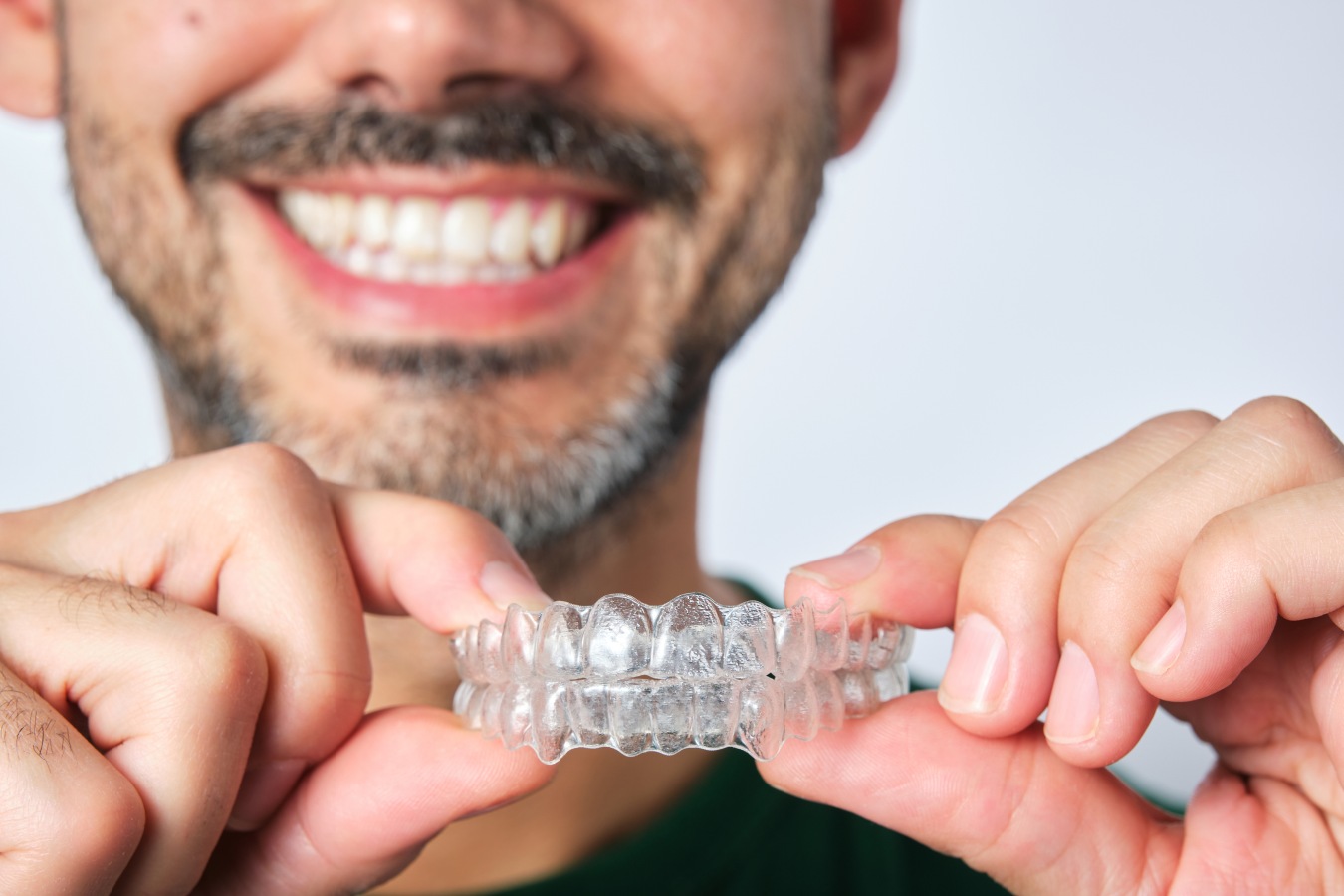
Invisalign really comes down to one feature that fits today’s active lifestyles: the trays come out. Practice, games, band rehearsal, work presentations, senior photos. Life doesn’t pause for orthodontic treatment, and clear aligners were built for exactly that.
At Hometown Orthodontics, our orthodontists have treated teens and adults with clear aligners for years, and the questions we hear most often are about wear time, cost, and whether Invisalign can handle a specific bite. Here are the answers.
What Is Invisalign? Clear Aligners Explained
Invisalign is a series of custom-made, removable clear plastic trays that gradually straighten teeth. Each tray applies gentle, planned pressure to shift teeth a small amount, and you move to the next set roughly every one to two weeks. Trays are worn 20 to 22 hours per day and come out for meals, brushing, and sports.
The trays are made from a multilayer thermoplastic material called SmartTrack, which Align Technology developed to deliver steady, predictable force instead of the sharp pressure of thicker plastics. That material also gives the aligners their nearly invisible look.
Planning starts with digital intraoral scanning. A small wand captures thousands of images of your teeth and bite, which means no goop and no gagging on old-fashioned impression trays. The scan builds a precise 3D model that becomes the foundation of your personalized plan.
Each tray in your series is numbered, and the set arrives in sequence so you always know which one comes next. You keep a case in your bag, rinse the trays with cool water when you take them out, and brush them gently at night before they go back in. Cool water matters here, since hot water can distort the plastic enough to change the way a tray fits.
Aligners also work in partnership with your own habits. Teeth move through bone, and that bone needs steady, uninterrupted pressure to remodel around the new position. Long breaks let teeth settle back toward where they started, which is why a tray that spends the whole evening on the kitchen counter costs you more than one evening.
Because the trays are clear and thin, most people won’t notice you’re wearing them. That matters to a high school pitcher, a flute player, a bride, and a sales manager who spends the day on video calls.
Invisalign can correct crowding, spacing, and many bite problems. What it can’t do is work while it’s sitting in a backpack, which is why wear time is the single biggest factor in your result.
How Invisalign Treatment Works, Step by Step
Invisalign treatment works in five steps: a free consultation with digital scans, a 3D plan that previews your projected final smile, fabrication of your custom tray series, wearing each tray on the schedule we set, then retainers once your teeth are in position. Most cases finish in about 6 to 18 months, depending on complexity.
Here’s what each step looks like in practice:
- FREE consultation and digital scan. Our orthodontists examine your teeth, gums, and bite, take digital X-rays, and capture a full intraoral scan. You’ll learn right away whether aligners suit your case.
- 3D planning. We map the exact sequence of tooth movements and can show you a digital preview of where your smile is headed before a single tray is made.
- Aligner delivery. Your custom tray series arrives, and we fit the first set, check the seal, and show you how to insert and remove them without cracking the plastic.
- Attachments and wear. Some cases need small tooth-colored attachments bonded to a few teeth so the trays can grip and rotate them. You wear each tray as scheduled and use aligner chewies to seat them fully.
- Check-ins and retainers. We see you at Hometown Orthodontics every 6 to 10 weeks to confirm the teeth are tracking with the plan. When active treatment ends, retainers hold everything in place.
Two terms are worth knowing before you start: tracking and refinement. Tracking describes how closely your teeth are following the digital plan, and our orthodontists check it at every visit by looking at how completely each tray seats against the edges of your teeth. If one tooth lags behind, we can adjust the sequence, add an attachment, or order a short refinement series at the end to fine-tune the finish. Refinement trays are common in aligner treatment, not a sign that something has gone wrong.
Simple cases can wrap up in well under a year. Bite correction and significant rotations take longer. Our orthodontists will give you a realistic estimate at your first visit rather than a guess.
Why Clear Aligners Fit an Active Lifestyle
Removability is the whole story. Anything that would normally complicate treatment becomes a two-second decision instead. A wrestling match, a slice of pizza at halftime, a class photo you didn’t know was happening: trays out, handle it, trays back in.
- Sports come first. Pop the trays out, put in your mouthguard, and play. No bracket cutting your lip after a collision.
- Band and choir stay comfortable. Wind and brass players adjust to smooth plastic far more easily than to metal brackets on the front of the teeth.
- No food restrictions. Popcorn at the football game, corn on the cob at the family cookout, caramel apples in October. Remove your trays, eat, rinse, brush, and put them back in.
- Brushing and flossing stay simple. No threading floss under a wire. Good hygiene during treatment protects your enamel and gum health, which is one reason many families lean toward aligners.
- Fewer emergency visits. There are no brackets to break and no wires to poke, so unexpected visits are rare.
- Travel-friendly. Heading out for a tournament, a mission trip, or a long work stretch? We can send you ahead with the next few trays instead of rescheduling everything.
- Photo-ready in seconds. Senior pictures, weddings, job interviews. The trays are already nearly invisible, and they come out entirely if you’d rather.
The flip side of that freedom is bookkeeping. Twenty to twenty-two hours a day leaves roughly two hours for meals, which sounds generous until you add up a slow breakfast, a long lunch with friends, and a plate of nachos after a game. Families who do well with aligners usually build a routine around them: trays out at the table, case on the counter where nobody throws it away, trays back in before the dishes are finished.
One honest trade-off: aligners only work when they’re in your mouth. Teens who tend to forget things may do better with braces, and our orthodontists will tell you that straight up during your FREE consultation rather than after you’ve committed.
Invisalign vs. Braces: Comparing Your Options
Both treatments move teeth well. The right choice depends on your bite, your habits, and what you want the process to feel like.
| Feature | Invisalign | Metal Braces | Clear Braces |
|---|---|---|---|
| Visibility | Nearly invisible | Most noticeable | Less noticeable than metal |
| Removable | Yes, for eating and sports | No | No |
| Diet | No restrictions | Avoid hard, sticky foods | Avoid hard, sticky foods |
| Hygiene | Brush and floss normally | Requires extra technique | Requires extra technique |
| Visit frequency | Every 6 to 10 weeks | Every 4 to 8 weeks | Every 4 to 8 weeks |
| Complex cases | Many, with limits | Handles the widest range | Handles a wide range |
| Depends on patient effort | Heavily | Minimally | Minimally |
Braces still have a clear edge for severe rotations, large gaps, significant bite discrepancies, and cases where teeth need to be moved long distances. Brackets are bonded to the teeth, so the appliance is working 24 hours a day whether you think about it or not.
Clear braces sit in the middle. They use the same components as traditional metal braces with tooth-colored or ceramic brackets, so they’re much less noticeable while still handling complex movements. Lingual braces go a step further by attaching to the back, or lingual, side of your teeth where nobody sees them at all.
For similar case difficulty, treatment times are often comparable. The bigger difference is the day-to-day experience, plus the discipline aligners require.
How Much Does Invisalign Cost?
Invisalign cost depends on three things: how complex your case is, how long your teeth need to move, and how many trays your plan requires. Simple crowding or spacing costs less than full bite correction. Insurance orthodontic benefits, FSA or HSA dollars, and monthly payment plans lower what you actually pay out of pocket.
Two cases that look similar in the mirror can carry different fees, because the number of planned movements is what drives the length of the tray series. That’s also why an online price range only tells you so much. A full exam with digital scans is what turns a range into an actual number you can plan around.
| Factor | Effect on Cost |
|---|---|
| Case complexity | Mild alignment costs less than full-arch bite correction |
| Number of trays | More movements mean more aligners in the series |
| Treatment length | Longer cases involve more visits and monitoring |
| Refinement trays | Some plans include a second short series for fine-tuning |
| Retainers | Usually part of the total investment, so ask what’s included |
| Insurance benefits | Many dental plans include orthodontic coverage, though amounts vary by plan |
A few things worth asking about before you start:
- Does the quoted fee include retainers and any refinement trays?
- What are the monthly payment options, and is interest-free financing available?
- How much of your orthodontic benefit remains for this plan year?
- Can you use FSA or HSA dollars toward the balance?
Timing can matter, too. Orthodontic benefits often reset with the plan year, and starting close to a reset can spread coverage across two benefit periods instead of one. FSA and HSA contributions run on a calendar of their own. Our awesome staff will run the numbers both ways so you can see whether waiting a few weeks changes anything for your family.
Ask for a written estimate at your FREE consultation. You should walk out knowing the total fee, the payment schedule, and what your insurance is expected to cover, with no surprises halfway through treatment.
Are You a Good Candidate for Clear Aligners?
Most teens and adults with mild to moderate orthodontic concerns are candidates for Invisalign. A full exam with digital scans is the only way to know for certain, but these general guidelines are a good starting point.
Clear aligners often work well for:
- Crowded teeth that overlap or twist
- Gaps and spacing between teeth
- Mild to moderate overbite, underbite, or crossbite
- Relapse after previous braces, when teeth have drifted since the retainer stopped fitting
- Adults who want discreet treatment during their working years
Clear aligners require:
- Consistent wear of 20 to 22 hours every day
- Healthy teeth and gums before treatment starts, so cavities and gum inflammation get addressed first
- Willingness to keep a case handy and not lose trays at lunch
Braces may be the better choice for:
- Severe skeletal bite problems
- Teeth needing large movements or significant rotation
- Younger patients still in active growth stages, evaluated case by case
- Anyone who knows honestly that they won’t keep up with wear time
The exam itself is straightforward. Our orthodontists look at how your teeth meet, measure the crowding, check the health of the gums and enamel, review digital X-rays for root position and any unerupted teeth, then weigh what aligners can achieve against what brackets would achieve in the same mouth. You’ll hear both options and the reasoning behind the recommendation, including the honest limits of each.
Teens and adults both qualify, and growth-stage cases get evaluated individually. Some plans combine approaches, using braces first and aligners to finish, or the reverse.
Frequently Asked Questions About Invisalign
How long does Invisalign take?
Most Invisalign cases take about 6 to 18 months. Mild crowding or spacing can finish on the shorter end, while bite correction and complex rotations take longer. Your total time depends heavily on wearing each tray 20 to 22 hours a day, since teeth only move when the aligners are in.
Does Invisalign hurt?
You’ll feel mild pressure or tightness for a day or two after switching to a new tray, which is the sensation of teeth moving. Most people describe it as awareness rather than pain, and it fades quickly. Switching trays at bedtime helps you sleep through the adjustment period.
Can I play sports with Invisalign?
Yes. Remove your trays before practice or a game, store them in their case, and wear your athletic mouthguard as usual. This is one of the biggest advantages aligners have over fixed braces for athletes, since there’s nothing bonded to your teeth to break on contact.
Can I drink coffee with my aligners in?
Water only. Coffee, tea, sweet tea, and sports drinks can stain the plastic, and warm liquids may warp the trays. Anything with sugar or acid that sits between the aligner and your teeth also raises your cavity risk. Take the trays out, enjoy your drink, rinse, and reinsert.
How often will I need check-in visits?
Usually every 6 to 10 weeks. These visits at Hometown Orthodontics are quick, and our orthodontists confirm your teeth are tracking with the digital plan, place or adjust attachments if needed, and hand off your next set of trays. If you’re traveling, we can often send extra trays with you.
Do I need retainers after Invisalign?
Yes. Teeth naturally drift over a lifetime, so nightly retainer wear is what preserves the result you worked for. We’ll fit your retainers as soon as active treatment ends and explain exactly how long to wear them each day. Some families do best with a clear removable retainer, others with a thin wire bonded behind the front teeth, and some use both together. Retainers aren’t optional, they’re the finish line.